
Test cricket is a concept for staying energy, problems, and lengthy innings. A century (100 runs) in this layout is already a prime success. But when a batter reaches a hundred at lightning tempo, it turns into a historic 2d. In this newsletter, we explore the fastest hundred in Test cricket, evaluate legendary knocks, study participant performances, assess a well-known suit, and present mounted statistical tables.
Table of Contents
What Does “Fastest Hundred in Test” Mean?
The time period for the quickest hundred in Test cricket refers back to the fewest balls confronted by way of the use of a batter to reap a hundred runs. It isn’t primarily based on minutes or overs but strictly on deliveries faced. This document highlights aggressive batting and fantastic strike prices inside the longest format of the game.
Fastest Hundred in Test Cricket – All-Time Records
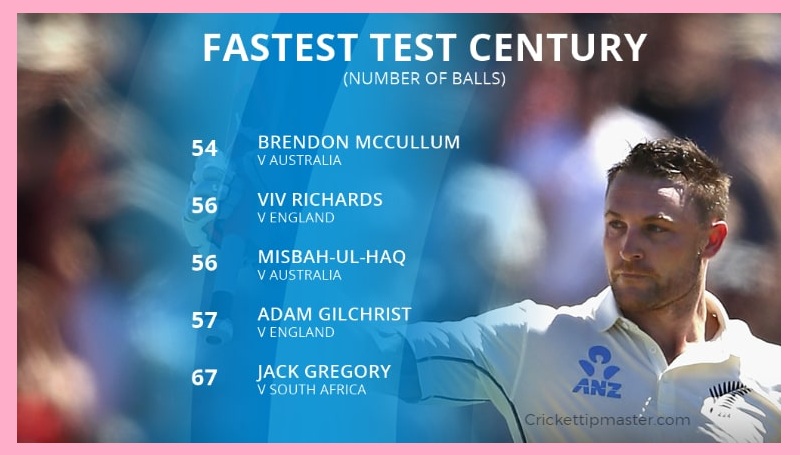
Here is a confirmed listing of the fastest Test centuries based totally on balls confronted:
| Rank | Player | Country | Balls to 100 | Opponent | Venue | Year |
|---|---|---|---|---|---|---|
| 1 | Brendon McCullum | New Zealand | 54 balls | Australia | Christchurch | 2016 |
| 2 | Viv Richards | West Indies | 56 balls | England | St John’s | 1986 |
| 2 | Misbah-ul-Haq | Pakistan | 56 balls | Australia | Abu Dhabi | 2014 |
| 4 | Adam Gilchrist | Australia | 57 balls | England | Perth | 2006 |
| 5 | Jack Gregory | Australia | 67 balls | South Africa | Johannesburg | 1921 |
| 6 | Shivnarine Chanderpaul | West Indies | 69 balls | Australia | Georgetown | 2003 |
| 6 | David Warner | Australia | 69 balls | India | Perth | 2012 |
| 6 | Travis Head | Australia | 69 balls | England | Perth | 2022 |
| 9 | Chris Gayle | West Indies | 70 balls | Australia | Perth | 2009 |
| 10 | Roy Fredericks | West Indies | 71 balls | Australia | Perth | 1975 |
Key Insight: The benchmark stays at 54 balls, set by Brendon McCullum—however, it is the quickest hundred in Test cricket records.
Match Review: Brendon McCullum’s 54-Ball Century (2016)
One of the most unforgettable moments in Test cricket came during New Zealand vs Australia, Christchurch, February 2016.
Match Context
- This become McCullum’s final healthy Test.
- Expectations have been excessive, but no man or woman anticipated records
The Knock
- McCullum smashed a century in a sincere 54 balls
- He attacked from ball one
- Dominated both pace and spin
Final Score
- 145 runs off seventy-nine balls
- Strike price above one hundred and eighty
Why This Innings Matters
- Fastest century in Test statistics
- Came in a farewell wholesome
- Changed the tempo of the game
- Became an iconic cricket memory
Even despite the fact that New Zealand misplaced the test, McCullum’s innings overshadowed the stop-quit end result.
Head-to-Head Comparison: McCullum vs Richards vs Misbah
| Player | Balls to 100 | Style | Impact |
|---|---|---|---|
| Brendon McCullum | 54 | Ultra-aggressive | World Record |
| Viv Richards | 56 | Dominant stroke play | The record stood 30 years |
| Misbah-ul-Haq | 56 | Calculated aggression | Equalled Richards |
Analysis
McCullum’s Edge:
- Fastest through balls
- Higher strike rate
- Modern bowling assault
Richards’ Brilliance:
- Achieved within the Eighties
- Against robust England side
Misbah’s Surprise:
- Known for calm batting
- Delivered explosive innings
Legendary Fastest Test Hundreds – Player Performances
Brendon McCullum
- Balls: 54
- Runs: 145
- Role: Captain
- Legacy: Fastest hundred in Test cricket
Viv Richards
- Balls: 56
- Runs: 110*
- Reputation: Fearless batting icon
Misbah-ul-Haq
- Balls: 56
- Runs: one 0 one*
- Special Note: Equalled Richards’ lengthy-fame record
Adam Gilchrist
- Balls: 57
- Known For: Explosive wicketkeeper-batsman
- Revolutionized attacking Test batting
David Warner
- Balls: 69
- Opponent: India
- Style: Aggressive starting batter
Travis Head
- Balls: 69
- Modern-era counter-attacker
- Played one of the fastest Ashes centuries
Fastest Hundred in Test Cricket—Then vs Now
Earlier Era
- Defensive thoughts-set
- Focus on time spent at crease
- Strike charges an amazing deal much less critical
Modern Era
- Positive cause
- Counterattacking strategies
- High strike expenses valued
Players like Gilchrist, McCullum, and Head reshaped how Test batting is approached.
Why a Fast Century Changes Test Matches
A fast hundred can:
- Shift wholesome momentum
- Put bowlers under strain
- Speed up scoring charge
- Turn draws into wins
- Energize the dressing room
Even in a layout built on staying power, aggression has become an effective weapon.
Statistical Trends—Quickest Centuries Insights
- Many of the quickest Test loads took place in Perth (rapid pitch)
- Aggressive wicketkeeper-batsmen characteristic prominently
- Strike fees frequently exceed 150+
- Modern cricket sees greater attacking Test innings
CONCLUSION
The fastest hundred in Test cricket is one of the most interesting data in the game. Brendon McCullum’s 54-ball century stays unmatched—in fact, it is the best mixture of courage, capability, and timing.
From Viv Richards’ dominance to Misbah-ul-Haq’s marvelous fireworks and Travis Head’s modern-day aggression, rapid centuries display that Test cricket is a protracted way from sluggish. These innings deliver pleasure, drama, and unforgettable memories to the longest format.
Test cricket rewards staying strength but celebrates fearless brilliance.
FAQ – Fastest Hundred in Test Cricket
Q.1. Who scored the quickest hundred in Test cricket?
Answer: Brendon McCullum—54 balls vs Australia (2016).
Q.2. What is the second quickest Test century?
Answer: Viv Richards and Misbah-ul-Haq—56 balls.
Q.3. Has each person damaged McCullum’s fifty 4-ball report?
Answer: No. It nonetheless stands as the fastest Test hundred.
Q.4. Which Australian participant has the quickest Test century?
Answer: Adam Gilchrist—57 balls vs England (2006).
Q.5. Why are the fastest Test centuries uncommon?
Answer: Because Test cricket prioritizes wicket protection and lengthy innings over brief scoring.
Q.6. Is a brief century continually beneficial for the team?
Answer: Often yes; however, fit and situations depend.